
Every summer, hundreds of thousands of Torontonians face the same question: go north on the 400 to Muskoka, or head northeast through the 407 corridor to the Kawarthas? The Muskoka vs Kawartha Lakes debate is one of Ontario’s great cottage country comparisons, and it is not as simple as most people assume.
Both regions deliver lakes, docks, and the kind of slow mornings that make a cottage weekend worth the drive. But they are genuinely different places, with different water, different towns, different price points, and a very different Friday drive from Toronto.
This is a real side-by-side Ontario cottage country comparison, not a ‘they’re both great, it depends’ article. Here is what each region actually looks like to book, drive to, spend a weekend in, and pay for in 2026.
At-a-Glance: Muskoka vs Kawartha Lakes
| Category | Muskoka | Kawartha Lakes |
|---|---|---|
| Drive from Toronto (off-peak) | 1h 45m to 2h 15m via Hwy 400/11 | 1h 30m to 1h 50m via Hwy 407/35/115 |
| Drive from Toronto (Friday peak) | 3 to 4+ hours | 2 to 2.5 hours |
| Avg cottage rental/night (peak summer) | $900 to $1,800 CAD | $375 to $600 CAD |
| Water type | Deep, cold, Canadian Shield lakes | Warmer, calmer, connected waterway |
| Number of lakes | 1,600+ | 250+ (interconnected via Trent-Severn) |
| Boating style | Self-contained lakes | Multi-lake routes via Trent-Severn Waterway |
| Main towns | Port Carling, Bracebridge, Gravenhurst | Bobcaygeon, Fenelon Falls, Lindsay |
| Best for | Luxury, prestige, special occasions | Families, value, fishing, waterway boating |
| Crowds (July/August) | Heavy. Hwy 400 is a parking lot. | Moderate. Corridor traffic much lighter. |
| Booking lead time (peak) | 4 to 6 months out | 6 to 10 weeks out |
Kawarthas Cottage Weekend from Toronto: The Drive Nobody Warns You About
For a Kawarthas cottage weekend from Toronto, the route travels northeast via Highway 407 East to Highway 35/115 North, completely bypassing the Highway 400 corridor. Most drivers reach Bobcaygeon or Fenelon Falls in under two hours on a Friday evening.
Muskoka runs almost entirely on Highway 400, one of Ontario’s most congested summer corridors. A drive that takes 1 hour 45 minutes on a quiet Tuesday can stretch past four hours on a Friday evening in July.
The pinch point is the Toronto-to-Barrie stretch, and once you are in it, there is no meaningful shortcut. According to the Ontario Ministry of Transportation, traffic volumes on summer long weekends run roughly 25% above normal. On Victoria Day or Canada Day Friday, the 400 can feel like the city has collectively relocated north at 4pm.
The honest caveat on the Kawarthas: some county roads on the way to smaller lakes are unpaved or poorly maintained. Worth checking before arriving in a low-clearance vehicle. The Ontario 511 road conditions site is useful for this.
Bottom line on the drive: The Kawarthas win on Friday practicality. Muskoka wins on road infrastructure once you arrive.
The Water: Different Geology, Genuinely Different Experience
This distinction matters more than most people expect before booking a Kawartha Lakes cottage rental, or a Muskoka one.
Muskoka: Canadian Shield Lakes
Muskoka sits on ancient Precambrian granite, producing deep, cold, clear lakes with rocky shorelines and forested privacy.
Lake Muskoka reaches roughly 73 metres at its deepest point. Water stays cold through summer, which many swimmers prefer. Shorelines are often rocky, meaning slippery entry and no gradual wade-in for younger children.
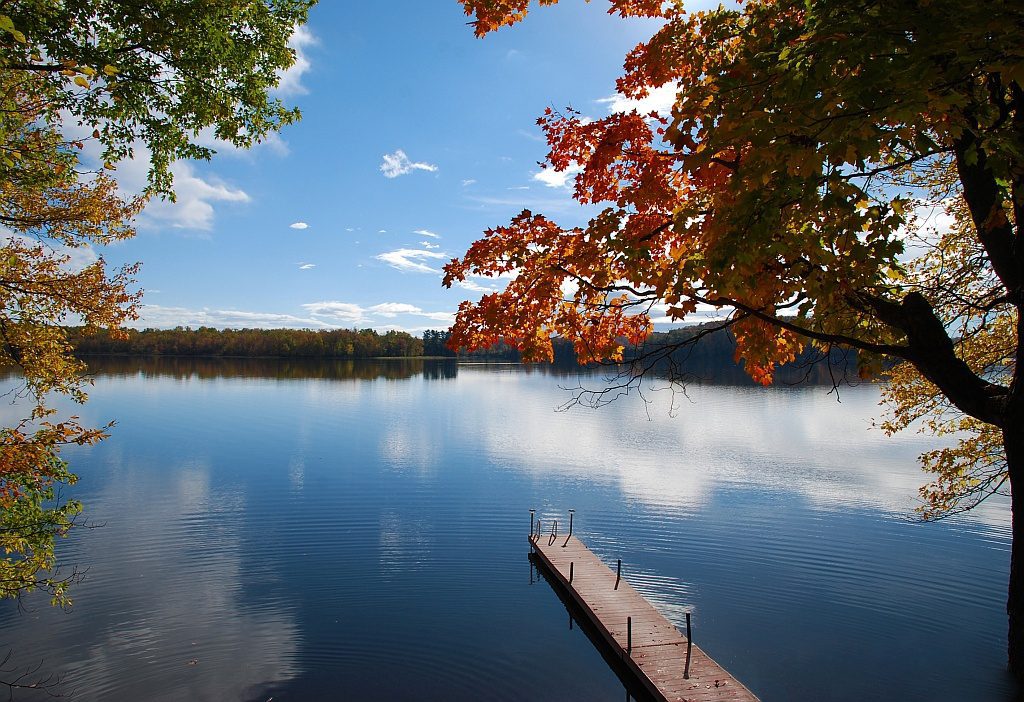
The scenery has a rugged, dramatic quality that photographs well and feels distinctly northern.
Kawartha Lakes: Limestone Bedrock, Warmer Water
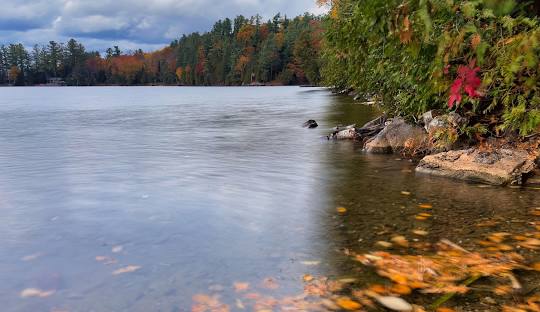
Kawartha Lakes occupy limestone bedrock south of the Shield. The result is shallower, warmer lakes with sandier shoreline entry. Balsam Lake reaches about 15 metres at depth and warms to comfortable swimming temperatures by late June.
Pigeon Lake spans roughly 5,300 hectares. Sturgeon Lake is regarded as one of Ontario’s best fisheries for walleye, muskie, and bass. For families with children under ten, the Kawarthas are the more practical choice: gradual entry, warmer water, fewer rocks underfoot.
The Trent-Severn Waterway: The Kawarthas’ Defining Feature
The Trent-Severn Waterway is a 386-kilometre navigable canal linking 14 interconnected lakes. In practical terms, you can spend a day boating from Bobcaygeon through Lock 32, across Sturgeon Lake, through Fenelon Falls’ Lock 34, and into Cameron Lake, all without trailering your boat.
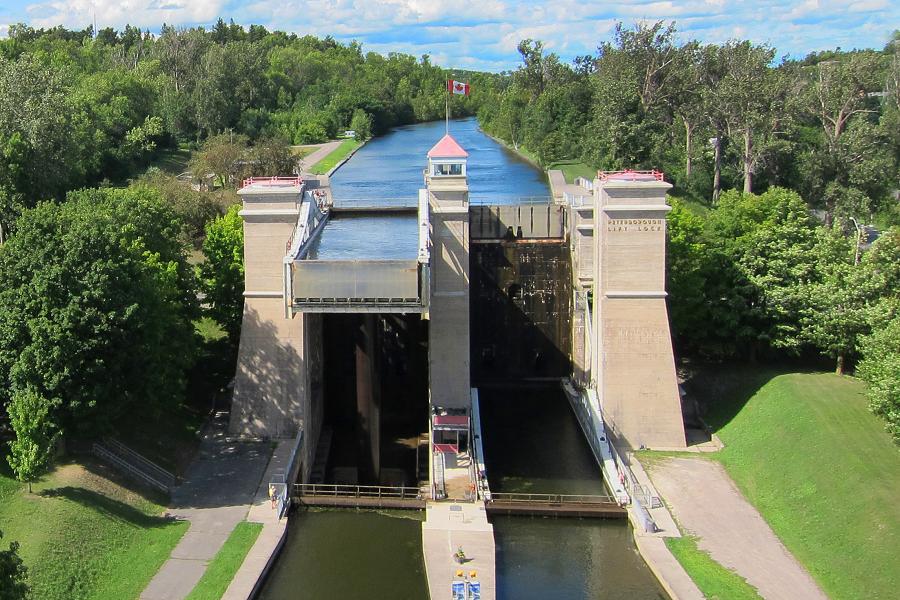
Muskoka lakes are spectacular but self-contained. That kind of multi-lake boating simply does not exist there. You can read more about the Waterway on the Parks Canada Trent-Severn page.
The Towns: Port Carling vs Bobcaygeon
Muskoka Towns
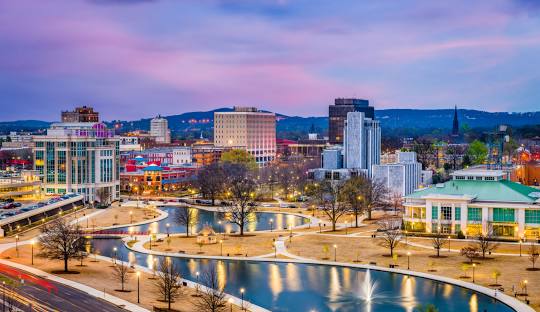
Port Carling, Bracebridge, Gravenhurst, and Huntsville have been catering to Toronto visitors for over a century. Port Carling, the ‘Hub of the Lakes,’ offers waterfront dining at PIE Wood Fire Pizza and Gato Gato, boutique shopping, and boat cruises from the locks.
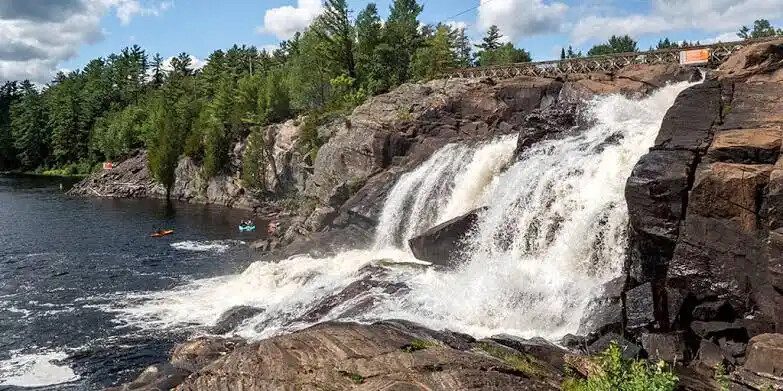
Bracebridge has Bracebridge Falls, restaurants from pub staples to Japanese fusion at Wabora, and the Muskoka Brewery in Gravenhurst offering tours and tastings.
The Kee to Bala is a genuine piece of Ontario music history, a live venue since 1942 that still draws national acts through summer.
Trade-off: Muskoka towns are tourist-priced. Groceries in Port Carling carry a cottage-country premium, and restaurant bills accumulate fast in peak season.
Kawartha Lakes Towns
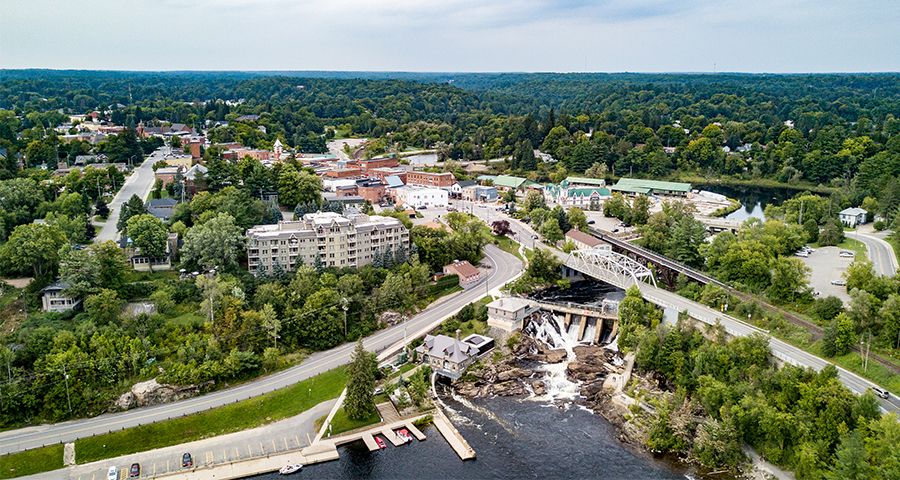
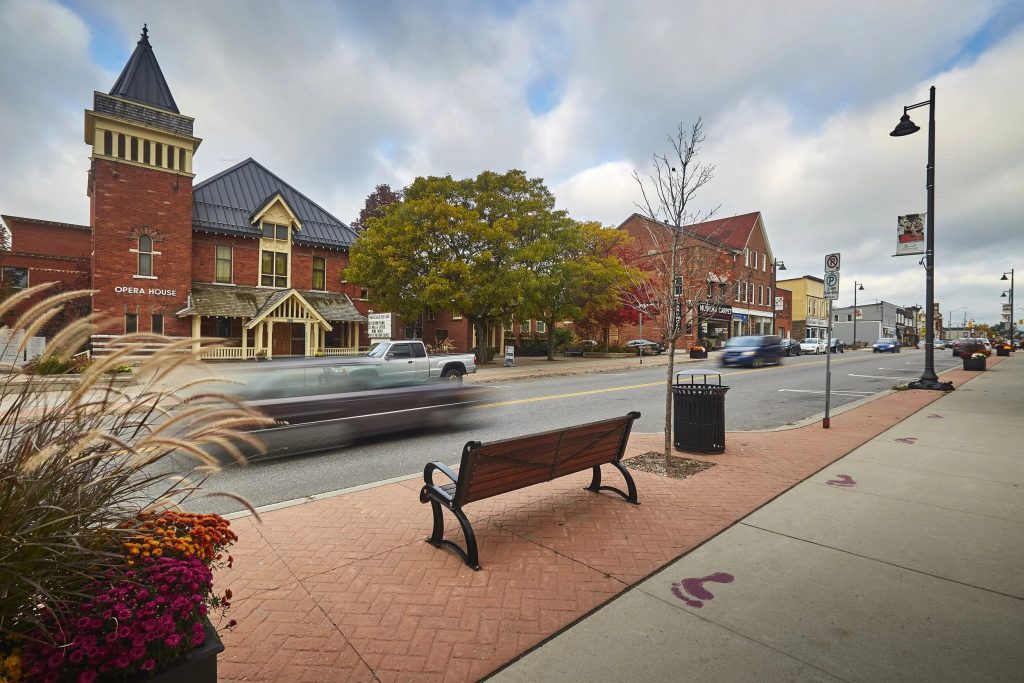
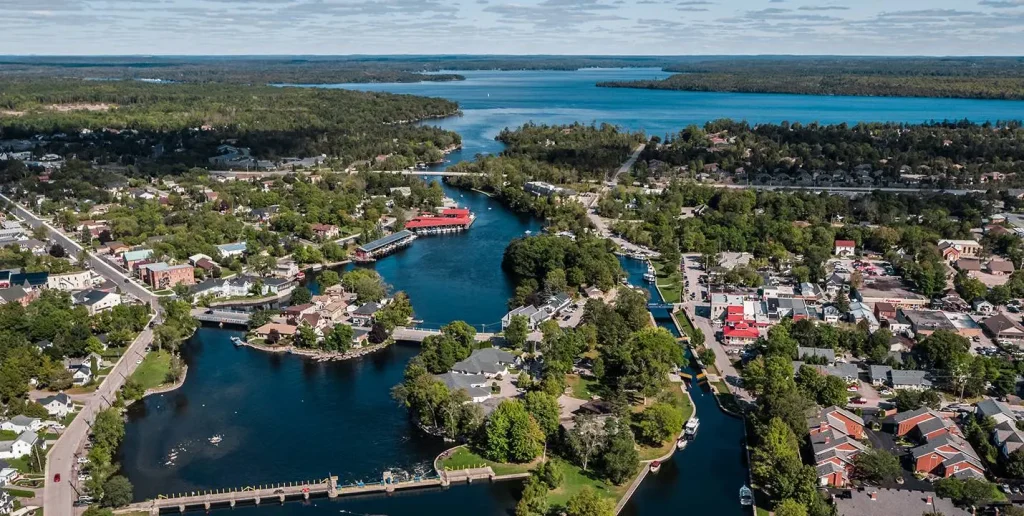
Bobcaygeon, made famous by The Tragically Hip’s 1998 song, sits at the junction of Pigeon and Sturgeon Lakes with a walkable Bolton Street downtown. Old Dog Brewing Company at 30 King St E does craft beer with local sourcing and a year-round taproom.
The Kawartha Settlers’ Village on the edge of town (open May through September) covers 20+ historic buildings from 1830 to 1935. It hosts the Craft Beer and Food Festival each August with nine breweries, local food vendors, and live music.
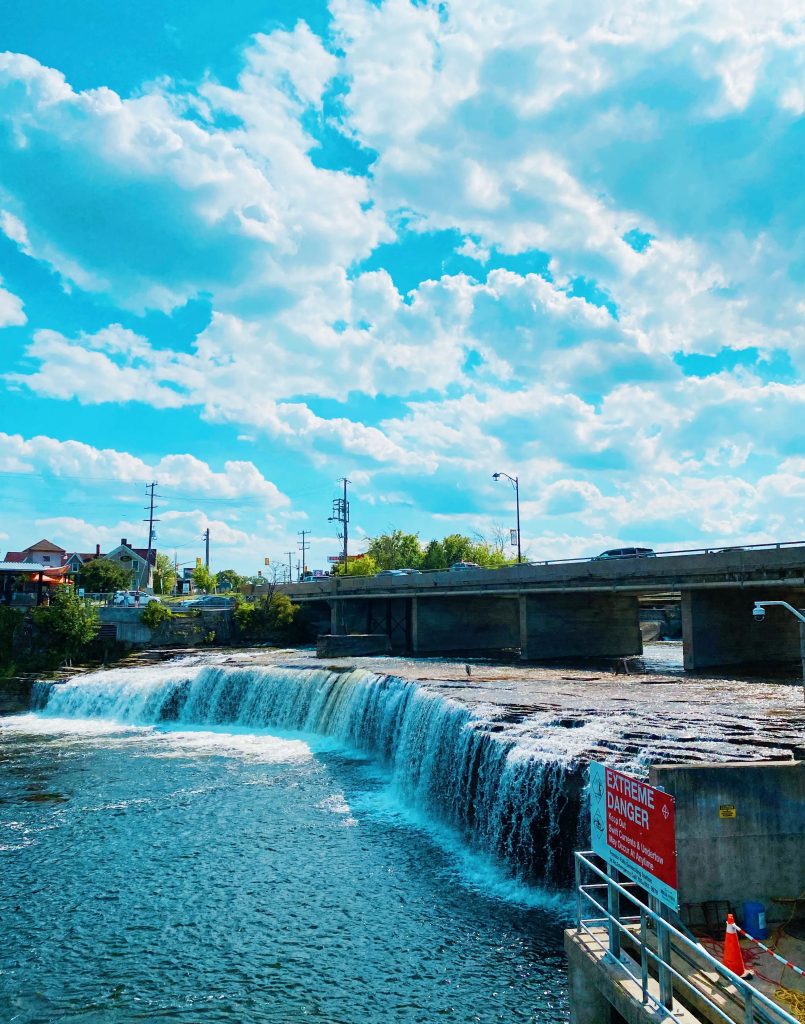
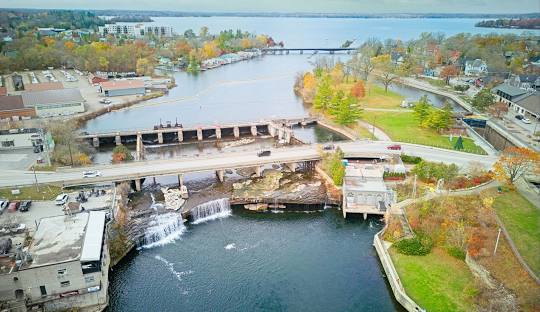
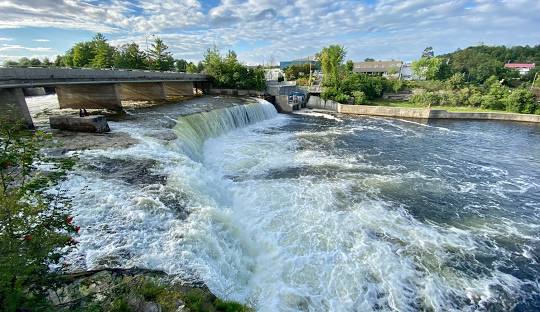
Fenelon Falls, the ‘Jewel of the Kawarthas,’ is the most photogenic town in the region. Lock 34 runs through its centre with a 23-foot waterfall visible to passing boaters. Fenelon Falls Brewing Co. at 4 May St operates out of a 200-year-old building directly on the Waterway.
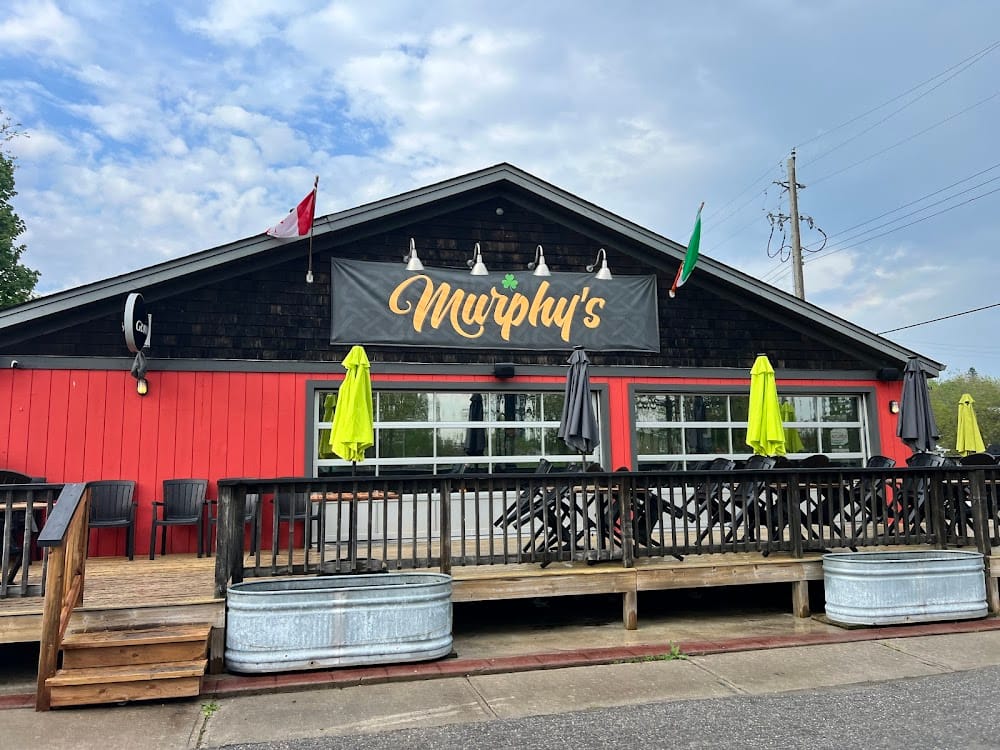
Murphy’s Lockside Pub and Patio at 3 May St lets you watch boats pass through the lock while drinking a local pour. The Grove Theatre pulls national performers to an outdoor amphitheatre through summer.
Lindsay, the largest city in the region, anchors the southern end with full supermarkets, pharmacies, and services at Toronto prices, not cottage-country markup.
Cost: The Kawartha Lakes Cottage Rental Advantage
This is where the Muskoka vs Kawartha Lakes comparison becomes most concrete.
Peak summer Kawartha Lakes cottage rentals average $375 to $600 CAD per night for a family-size property with private dock and full kitchen. Comparable Muskoka properties on premium lakes run $900 to $1,800 CAD per night.
The gap is consistently 30 to 40% in the Kawarthas’ favour, and it compounds across the whole trip. Groceries in Lindsay cost the same as in Toronto. Gas is regional market pricing. The Kawarthas’ cost advantage is not just the nightly rate.
Honest caveat: The top tier of Muskoka properties has no Kawartha equivalent. A ten-bedroom estate with a boathouse and 400 feet of frontage on Lake Rosseau does not exist in the Kawarthas. But for a well-equipped lakefront cottage at a price that does not require splitting costs six ways, the Kawarthas deliver.
Ontario Cottage Country Comparison: Outdoor Activities
| Activity | Muskoka | Kawartha Lakes |
|---|---|---|
| Multi-lake boating | No (self-contained lakes) | Yes, via Trent-Severn Waterway |
| Walleye and muskie fishing | Good | Outstanding (Sturgeon Lake) |
| Family beach swimming | Variable. Rocky entry common. | Excellent. Sandy, gradual shorelines. |
| Hiking | Algonquin Park access, Hazelwood Trail | 600+ km, Ganaraska, Trans Canada Trail |
| Cycling | Limited | Victoria Rail Trail, Four Villages Tour |
| Golf | Championship-level (Lake Joseph Club) | Good regional courses |
| Birding | Good | Carden Alvar, top 5 in Ontario |
| Winter | Snowshoe, ski, ice fishing | Snowmobile, ice fishing, Lakefield oval |
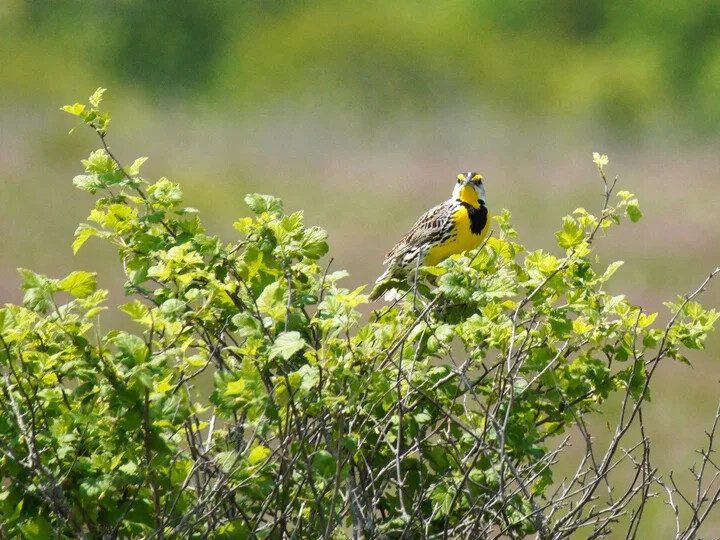
One note on the Carden Alvar: it is one of North America’s rarest geological habitats, supporting 200+ bird species including loggerhead shrikes and upland sandpipers. Birders who have dismissed the Kawarthas as just cottage country consistently report it as one of their top Ontario experiences. Nature Canada has a good overview of the site.
Muskoka’s proximity to Algonquin Provincial Park, accessible via Highway 60 from Huntsville, gives it an edge for backcountry canoeists. For serious wilderness access, that matters.
Nightlife and Dining
Muskoka has more infrastructure after dark. The Kee to Bala, Huntsville Festival of the Arts, sunset wine cruises on Lake Rosseau, and a dining scene running from casual pub food to respected fine dining. It is still cottage country, not a party destination, but it has more after-dark options than most Ontario alternatives.
Kawartha Lakes is quieter in the evenings. The brewery scene is solid: Fenelon Falls Brewing Co. and Old Dog Brewing in Bobcaygeon are both worth your time. The Grove Theatre provides quality live performance through summer. The Bobcaygeon Craft Beer Festival in August is worth building a trip around.

Honest caveat: If vibrant nightlife is part of your criteria, the Kawarthas will disappoint. Plan accordingly.
Is Kawartha Lakes vs Muskoka Cheaper? Crowds and Booking Windows
Both regions fill up in July and August. Muskoka fills faster and stays more crowded longer.
Peak Muskoka properties on Lake Rosseau or Lake Joseph need to be booked four to six months out for a July weekend. February bookings for a specific property on a specific lake are standard, not excessive. The August long weekend requires even earlier planning for premium properties.
Kawartha Lakes cottage rentals offer genuine flexibility by comparison. Quality lakefront options can often be secured six to ten weeks before a summer weekend.
Shoulder season, May, June, September, and October, has real availability in the Kawarthas, not just leftover inventory. The Trent-Severn waterway season runs mid-May through mid-October, giving the Kawarthas a legitimate extended boating window that Muskoka’s water temperature does not match.
Can You Visit Both?
Yes. A split itinerary, three nights in Kawartha Lakes then north to Muskoka for four nights, works logistically. The regions are about 90 minutes apart by car through Haliburton via Highway 35 North.
The drive through Haliburton itself is scenic enough to justify a slow afternoon. If you are choosing one region for a single booking, the sections below make the decision cleaner.
Choose Muskoka If…
- The prestige address is part of the experience
- You want deep, clear, cold Canadian Shield water and dramatic rocky scenery
- You are celebrating something significant, anniversary, milestone, proposal, and want a property that matches the occasion
- Algonquin Park backcountry access is on the agenda
- Budget is not the primary constraint and you are planning well in advance
- You want resort-level amenities: JW Marriott Rosseau, spa facilities, championship golf at the Lake Joseph Club
Choose Kawartha Lakes If…
- You are travelling with children under 12 who need warm, sandy, gradual water entry
- Multi-lake boating on the Trent-Severn Waterway is a priority
- You are driving from Toronto on a Friday and the Highway 400 backup is a dealbreaker
- Walleye and muskie fishing on Sturgeon or Pigeon Lake is on the list
- You want a quality Kawartha Lakes cottage rental without splitting costs across a large group
- You are planning a shoulder-season trip in May, June, September, or October
- Bobcaygeon and Fenelon Falls suit your style more than polished Muskoka cottage towns
Frequently Asked Questions
Is Kawartha Lakes cheaper than Muskoka for a cottage rental?
Yes, significantly. Kawartha Lakes cottage rentals average $375 to $600 CAD per night at peak summer, compared to $900 to $1,800 CAD per night on Muskoka’s premium lakes. Properties in the Kawarthas run 30 to 40% less than comparable Muskoka options across most of the market. Groceries and services do not carry the tourist premium you will find in Port Carling.
What is the drive time from Toronto to Kawartha Lakes vs Muskoka?
A Kawarthas cottage weekend from Toronto takes roughly 1.5 to 2 hours via Highway 407 East and Highway 35/115 North, bypassing the Highway 400 corridor entirely. Muskoka takes 1h 45m to 2h 15m in off-peak conditions, but extends to 3 to 4+ hours on summer Friday afternoons due to Highway 400 congestion between Toronto and Barrie.
Which is better for families, Muskoka or Kawartha Lakes?
Kawartha Lakes has a practical edge for families with younger children. The limestone-bedrock lakes warm earlier, stay shallower, and have more gradual sandy shoreline entry than Muskoka’s Canadian Shield lakes. For families where ease of swimming access matters more than scenery prestige, the Kawarthas are the more forgiving Ontario cottage country option.
What is the Trent-Severn Waterway and why does it matter?
The Trent-Severn Waterway is a 386-kilometre navigable canal connecting 14 lakes across the Kawarthas. It lets boaters travel between lakes, Bobcaygeon to Fenelon Falls to Cameron Lake, without trailering. This kind of interconnected multi-lake boating does not exist in Muskoka, where each lake is self-contained.
When should I book a Muskoka cottage for summer?
For July and August weekends on premium lakes, book four to six months in advance. Popular properties on Lake Rosseau book by February. Kawartha Lakes cottage rentals offer considerably more flexibility, with quality options bookable six to ten weeks out even in peak summer.
Is Muskoka worth the premium over Kawartha Lakes?
For specific trips, yes. The Canadian Shield scenery, the established dining scene, the water clarity, and the prestige address are real. For a once-a-year special occasion where the rental is a centrepiece, Muskoka delivers. For a regular family cottage weekend where the Ontario cottage country comparison comes down to value per night and a shorter Friday drive, the Kawarthas are the stronger practical choice.
What fishing is available in Kawartha Lakes compared to Muskoka?
Both regions offer excellent fishing. The Kawarthas, particularly Sturgeon Lake and Pigeon Lake, are regarded as among Ontario’s best for walleye, muskie, and bass. The Trent-Severn Waterway creates diverse lake habitats that support a broad range of species. Muskoka is strong for northern pike, lake trout, and smallmouth bass in its deeper Shield lakes.
What are the best towns to stay near in Kawartha Lakes?
Bobcaygeon and Fenelon Falls are the most visitor-friendly bases, with craft breweries, waterfront dining, and direct Trent-Severn Waterway access. Lindsay is the region’s largest centre and offers full services without tourist pricing. For fishing-focused trips, properties on Sturgeon Lake between Fenelon Falls and Bobcaygeon put you closest to the best water.
Ready to book your Ontario cottage?
Browse Kawartha Lakes vacation rentals on StayWithStay, direct from the host with no booking fees. Prefer Muskoka? See Muskoka vacation rentals on StayWithStay, or read our comparison of Algonquin Highlands vs Muskoka if you are still weighing Ontario cottage country options.